
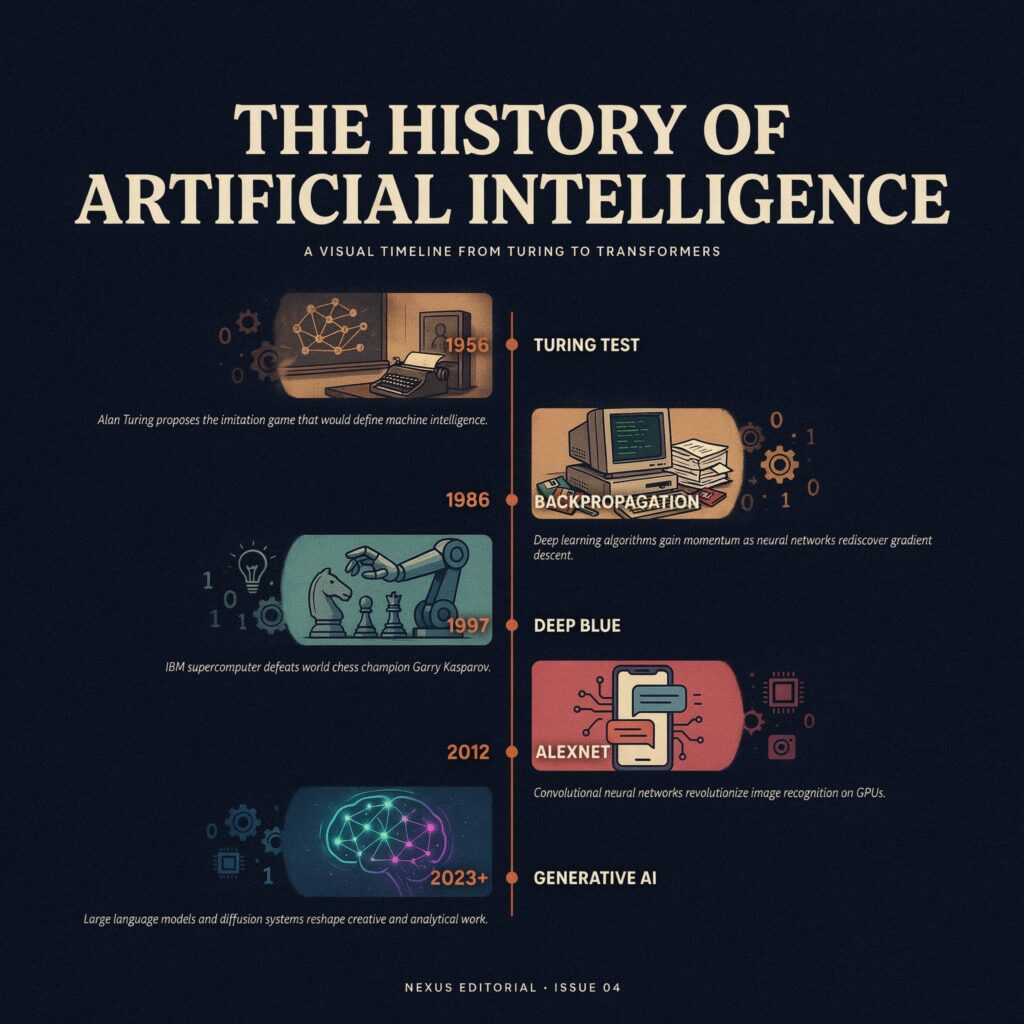
Start of AI [Artificial Intelligence History] The beginning of the history of artificial intelligence can be mapped back to the 1950s when researchers were searching for evidence that machines could simulate human intelligence (i.e., the ability to perform tasks that require intelligence). The term “artificial intelligence” was first popularized by the Dartmouth Conference (1956), which is widely regarded as the official history of artificial intelligence as it was the beginning of both an academic discipline and a new area of technology development created by computer scientists. Computer scientists in the 1950s believed that it was possible to create computers to think (i.e., to use reasoning), learn (i.e., to be able to store and retrieve information), and solve problems (i.e., the use of reasoning and learning to solve problems).
The 1960s and 1970s saw rapid growth in AI research; researchers created programs to solve math and recognize basic patterns in language. AI research suffered from limited processor power and a lack of data to the extent that these shortcomings led to “AI winters,” or periods of time that were marked by a decline in funding and interest in research in AI.
The AI Timeline and Development is traced through the mid-1980s, when the introduction of expert systems had a significant impact on AI because it included the ability to automate the decision-making process within an organization and represent human expertise, and became a common way to use computers as tools to create new products or enhance operations.